
10 Master Bedrooms Decor Above Bed Ideas

The wall above the bed is the single most important surface in a master bedroom. It is the first thing you see when you walk in and the anchor that sets the mood of the entire room. Leave it bare and the space feels unfinished, no matter how beautiful the bedding is. Fill it thoughtfully and the whole room suddenly looks styled, intentional, and complete.
The good news is that this wall is a natural stage for artwork and wall dressing of every kind. From one oversized canvas to a full salon-style gallery, from soft woven texture to the quiet drama of black-and-white photography, the space above the bed rewards a clear point of view. This guide collects ten artwork-focused ideas for real master bedrooms, with honest sizing advice, hanging tips, and finish guidance so you can pick the look that fits your room and hang it with confidence.
Idea 1: Oversized Single Canvas Statement
There is a particular confidence to hanging one large canvas above the bed. The trick is committing to scale: a small canvas centered over a wide headboard looks like an afterthought, but a piece spanning roughly two-thirds the bed’s width reads as deliberate. For a queen, look for 48 to 60 inches wide; for a king, 60 to 72 inches. Hang the bottom edge 8 to 12 inches above the headboard so art and bed read as one connected composition.
Abstract pieces are the most forgiving choice because they never fight the bedding pattern. Soft color-field canvases in muted tones pull a color from the pillows and echo it back larger. If bedding is patterned, keep the canvas quieter; if bedding is solid neutral linen, you can afford bolder movement and contrast. Choose decent depth, at least 1.5 inches of stretcher bar, so the canvas casts a soft shadow and feels substantial from the doorway.
Hanging matters as much as the art. Use two hooks or proper picture wire so the piece stays level, and anchor into studs or use real wall anchors for heavy pieces — never adhesive strips. A single picture light or a well-placed ceiling spot makes an oversized canvas glow in the evening, turning the focal wall into a gallery moment you see every night before sleep.
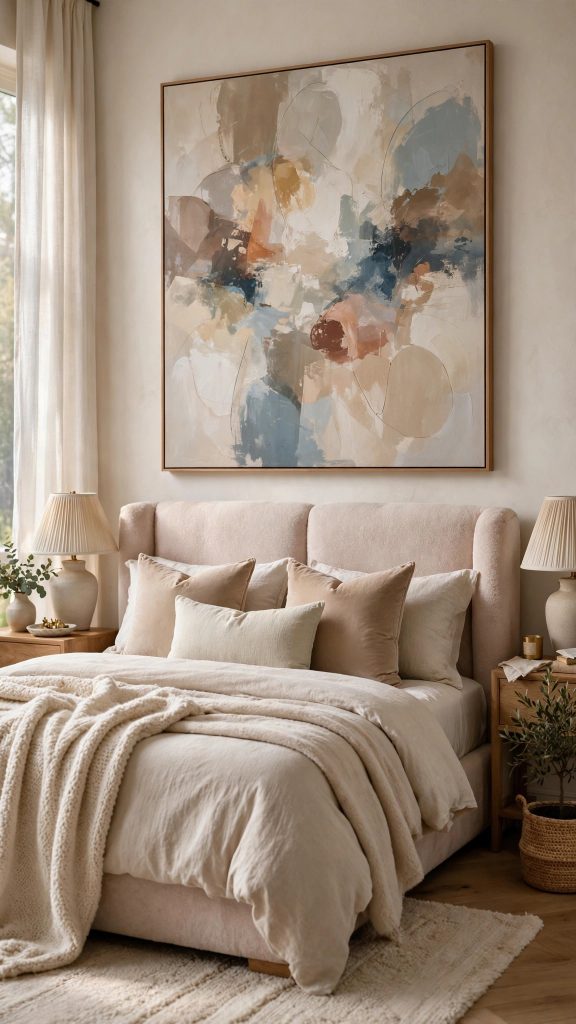
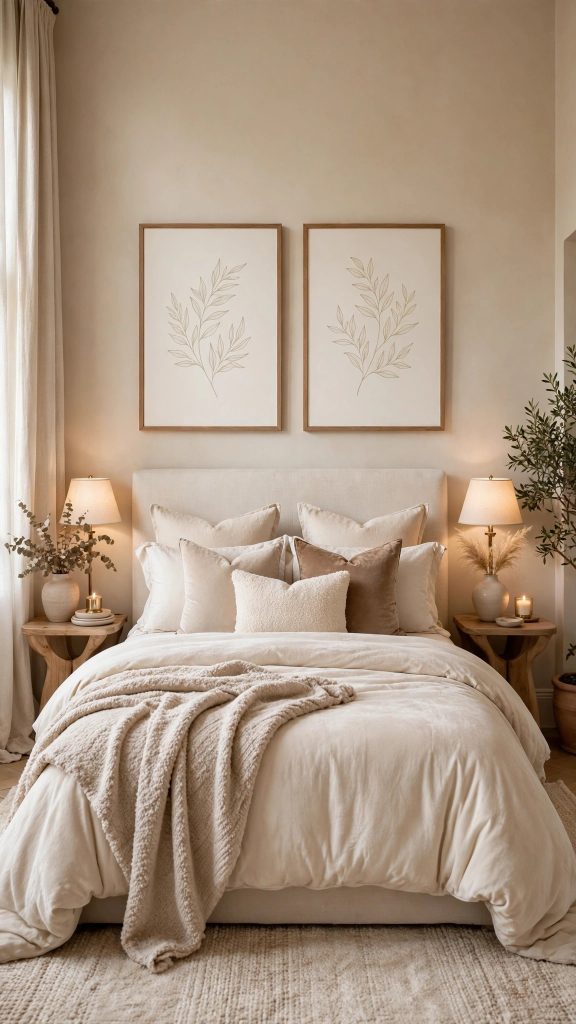
Idea 2: Symmetrical Framed Print Pair
A pair of matching framed prints brings order, balance, and calm. Symmetry reads as intentional without trying too hard, and it frames the headboard the way a good mat frames a photograph. Keep the two frames identical in size, profile, and mat; mismatched pairs drift into gallery-wall territory.
Size each frame generously: two 20-by-24 or 24-by-30 inch frames suit a queen; step up to two 24-by-36 over a king. Leave 2 to 4 inches between them so they read as a pair rather than one wide piece, and center the arrangement on the bed rather than the wall. Hang so the vertical midpoint sits around 57 to 60 inches from the floor, adjusting slightly for a tall headboard.
Choose images that relate: two landscapes from one series, two botanical studies, two line drawings in the same hand. A shared palette makes a pair sing, so pull two or three colors from the bedding and look for prints inside that family. Frame choice sets the tone — thin black metal reads modern, natural oak feels warm and Scandinavian, white keeps things airy. Keep the glass consistent across both frames, since mixed reflections will catch your eye every time you enter the room.
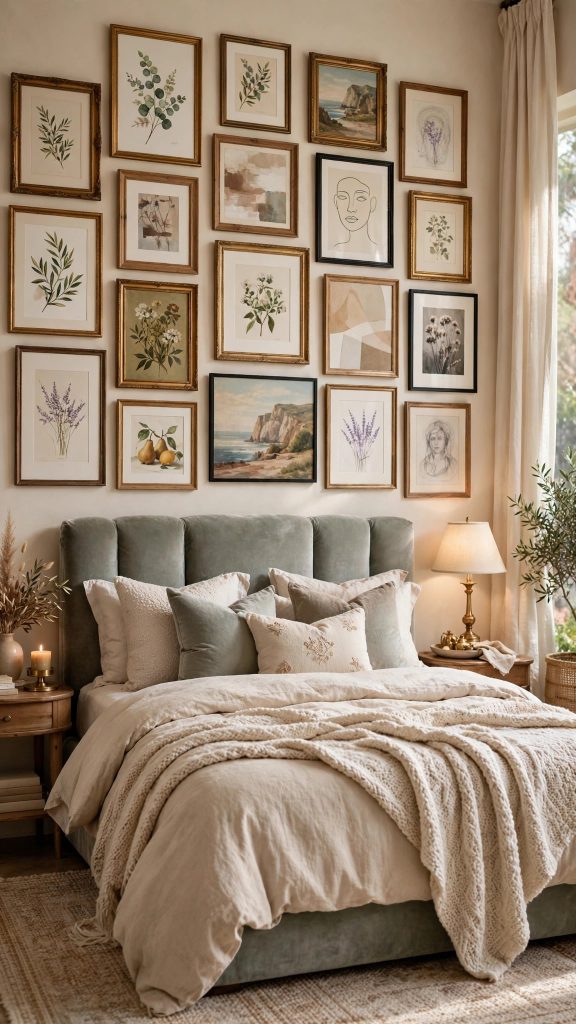
Idea 3: Salon-Style Gallery Wall
A salon-style gallery wall above the bed is for collectors and romantics who love a personal, collected feel. It is the most forgiving way to fill a wide wall. Mix frame sizes, orientations, and mediums: a watercolor, a photograph, a small textile, a vintage map of a place you love. What keeps variety from becoming chaos is a shared thread — an all-black frame family, a consistent warm mat tone, or a recurring color in nearly every piece.
Plan on the floor, not the wall. Lay the pieces out as you want them and keep 2 to 3 inches between frames. Build outward from a strong central piece and keep the overall shape roughly rectangular, echoing the bed below. Aim for the gallery to span about two-thirds the bed’s width, start hanging 8 to 10 inches above the headboard, and let the arrangement climb toward the ceiling.
The bedroom has one rule that overrides gallery convention elsewhere: keep it restful. Avoid neon, high-contrast chaos, or harsh edges that feel aggressive when you are half asleep. Lean into warm tones and muted palettes — this is a wall you see in morning light and lamplight. Paper templates taped to the wall before hanging save your paint and your patience.
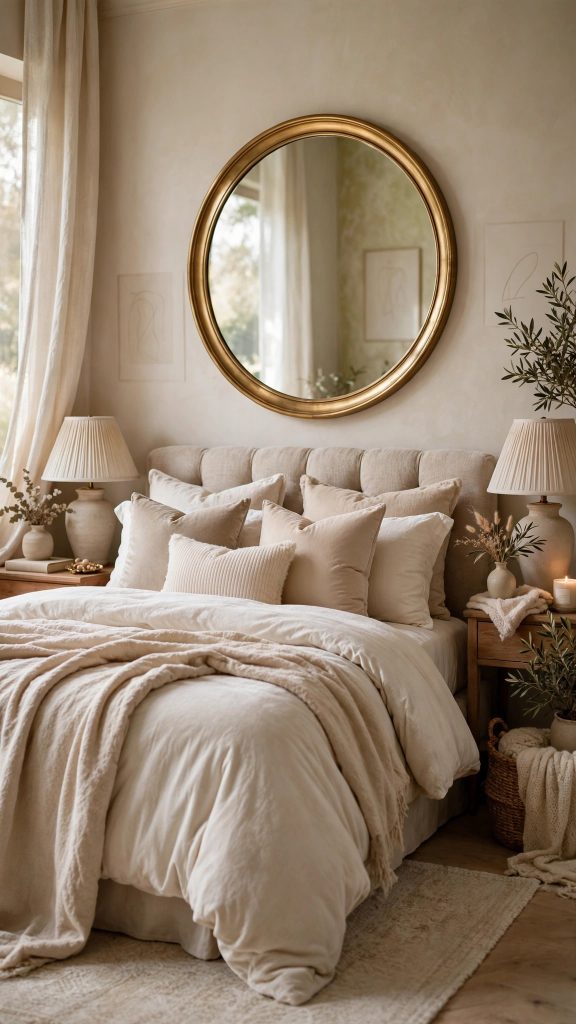
Idea 4: Round Mirror Focal Point
A round mirror above the bed bounces light and breaks up the room’s rectangles with a soft curve, making the space feel larger the moment you walk in. The round shape matters — a circle feels decorative and deliberate rather than borrowed from a hallway.
Scale is everything. For a queen, a mirror 30 to 36 inches in diameter fills the space without overwhelming it; for a king, 36 to 44 inches looks better. Hang it 8 to 12 inches above the headboard and center it on the bed. The frame carries the style: thin brass or gold adds warmth and a touch of glamour, black metal reads modern and graphic, wood keeps things relaxed. Mount with proper anchors — a securely hung mirror is no different from a securely hung frame.
Think about what the mirror reflects, since you see that view from the bed. Ideally it catches a window or a beautiful fixture opposite the bed, doubling the prettiest sight in the room. If it faces a closet or a cluttered wall, reconsider. You can soften the look by flanking the mirror with two small framed prints for a layered feel. Keep the glass clean — dust and fingerprints show immediately under picture lights and morning sun.
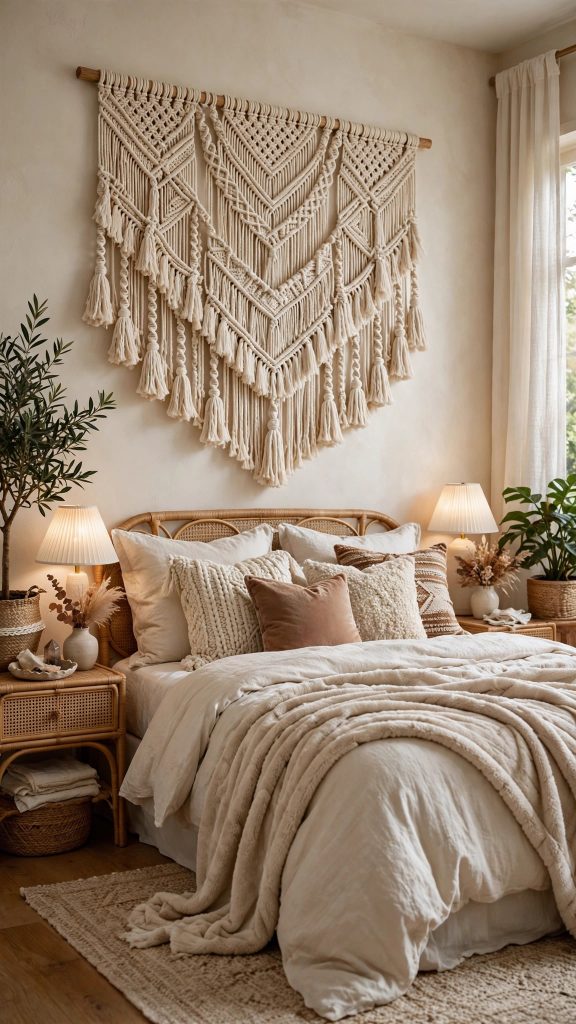
Idea 5: Woven Macramé Wall Hanging
Few things soften a master bedroom like a large woven macramé wall hanging. Its texture absorbs light and visual noise, adding a handmade warmth that makes a room feel like a retreat. This is the idea for bohemian, coastal, or relaxed modern bedrooms — and for anyone who wants above-bed decor that feels gentle rather than graphic. Undyed cotton cord in cream or natural beige works with almost any bedding and ages gracefully.
Choose a hanging that is wide rather than tall — roughly 36 to 48 inches across and 30 to 40 long for a queen. Hang it from a wooden dowel or a natural branch, and let the fringe fall freely; the fringe is part of the charm. Mount the dowel with small brackets or a sturdy hook, leaving 8 to 12 inches of breathing room above the headboard. If you rent, a large macramé piece is ideal: one strong hook does the job.
Styling rewards layered textures: linen bedding, a chunky knit throw, a rattan bench at the foot of the bed. The neutral tone never fights patterned pillows. One caution: in very humid rooms, natural cotton can hold moisture, so choose synthetic cord or keep it away from the ensuite side. Shake it out gently every few months so the cords stay full, and the piece will look better in year three than on day one.
Idea 6: Botanical Print Triptych
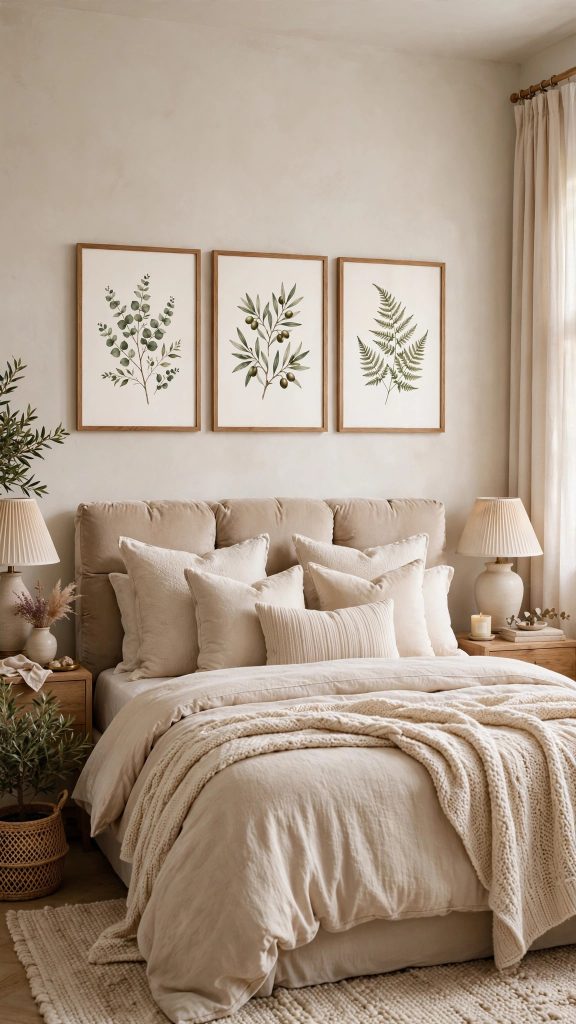
A botanical print triptych — three related prints in a row — is the Goldilocks option between a single canvas and a full gallery wall: structured, rhythmic, and elegant. Botanicals suit bedrooms because they are alive without being loud; leaf and floral studies in soft greens, creams, and ink tones feel restful. Vintage-style engravings add a collected, timeless quality, while modern pressed-leaf prints feel fresher and more contemporary.
Keep the three frames identical in size, style, and mat — that uniformity is what makes a triptych read as one artwork rather than three pictures. Each frame around 16-by-20 or 18-by-24 inches suits a queen; over a king, step up to 20-by-24 or 24-by-30. Space them 2 to 3 inches apart, align their centers, and span roughly two-thirds the bed’s width. Hang the center frame first, then build outward.
Frame choice shifts the mood dramatically. Slim black frames with white mats feel like natural-history plates — classic and refined. Light wood frames feel warmer and more casual, almost Scandinavian. In a sunny room, anti-glare or museum glass keeps reflections from washing out the prints each morning. Vary the subject — a fern, a branch, a bloom — while keeping the palette consistent for a collected feel.
Idea 7: Vintage Gold-Framed Oil Paintings
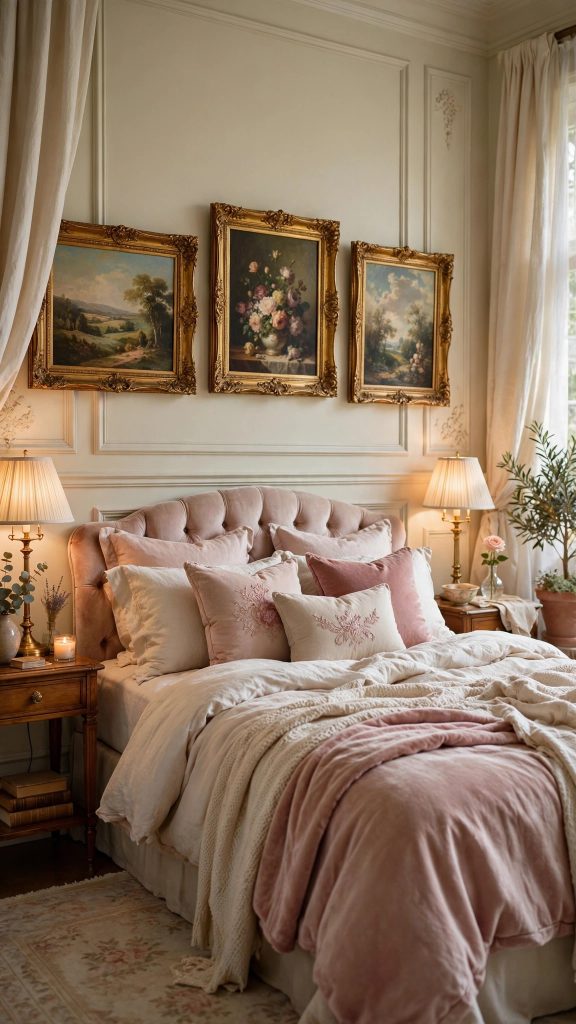
Nothing gives a master bedroom character faster than vintage oil paintings in ornate gold frames. The patina of an old frame, visible brushwork, slightly darkened varnish — these are things new art cannot fake, and they make a bedroom feel layered and storied. Flea markets and estate sales are full of affordable oils that look extraordinary hung with intention.
The frames do as much work as the paintings. Genuine gilt frames in warm gold flatter almost any palette, especially creams, taupes, and deep greens; antiqued silver or dark bronze gives the same vintage weight with a cooler tone. One large painting centered over the bed makes a grand romantic statement; two matching-size paintings side by side feel more traditional and balanced. Keep the art at least 8 inches above the headboard and respect the two-thirds-width guideline.
Lighting transforms vintage oils: a picture light or warm spot brings out the brushwork and makes gold frames glow at night. Hang each piece on two hooks or picture wire, and check the frame’s backing and wire before hanging — vintage frames sometimes need fresh wire or corner reinforcement. Protect paintings from direct sun, which fades old pigments quickly; if the wall faces a bright window, UV-filtering glass is worth the trouble for art that will outlive every trend.
Idea 8: Fabric Tapestry Panel
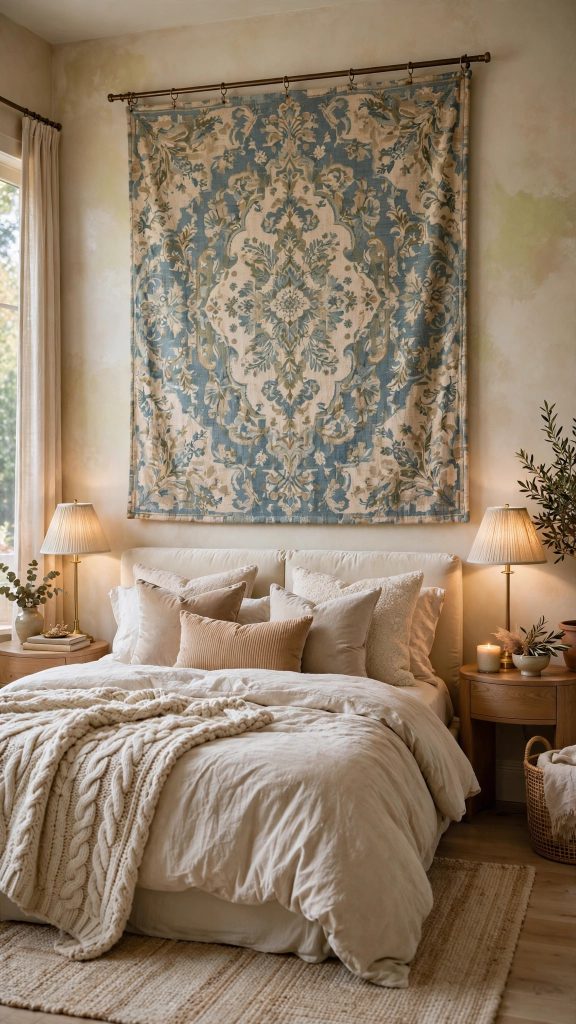
A large fabric tapestry panel above the bed brings color, pattern, and softness in one move. Fabric absorbs sound and softens the room’s acoustics, which matters in a space meant for rest. Choose a design you can live with daily: landscape scenes, abstract color washes, block prints, or subtle geometric weaves in a palette that echoes the bedding.
Size matters as much with fabric as with framed art: 50 to 60 inches wide over a queen, 60 to 72 over a king. Anything much smaller looks like a scarf someone left behind. Hang from a slim wooden or brass rod for a tailored look, or clip-style hangers for a relaxed drape. Keep the bottom edge at least 6 to 8 inches above the headboard so bedding never snags the fabric, and make sure the rod is level — fabric shows a tilt instantly.
Because tapestries are unframed, the wall color behind them matters; they look best against a calm, solid wall where the pattern can breathe. If the tapestry is bold, keep bedding simple; if subtle, you have more freedom with patterned pillows. A tapestry can be the room’s loudest pattern — one statement above the bed, everything else in quiet support — and the room feels complete without another object on that wall.
Idea 9: Sculptural Ceramic Wall Discs
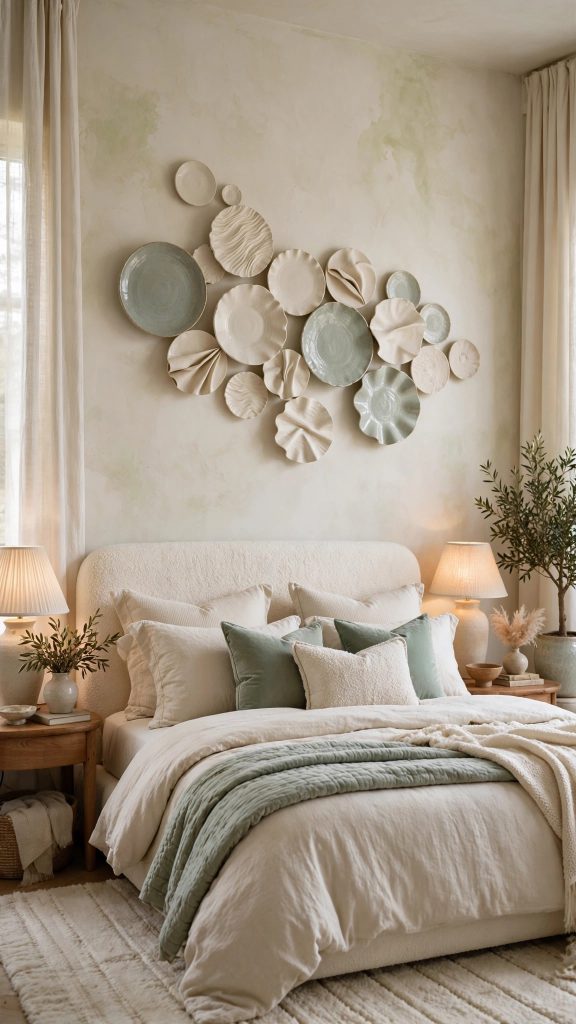
Sculptural ceramic wall discs are the quiet showstopper of above-bed decor: dimensional, tactile, and handmade-feeling. A cluster of glazed discs — whites, creams, soft celadon, or a pale-to-deep gradient — catches light differently through the day, so the wall feels alive. For minimal or modern-organic bedrooms, texture is the real luxury.
Composition is everything. Plan the cluster on the floor first: start with a central disc and build outward in a roughly oval shape about two-thirds the bed’s width. Vary disc sizes for a natural rhythm and keep 1 to 2 inches between pieces so each reads individually. Most discs have a hanging loop on the back; use small hooks rated for each disc’s weight, and tape paper templates to the wall before committing. Renters can choose a mounted panel of discs, which arrives as one framed piece.
Color sets the mood: all-white discs in varied textures feel serene and spa-like; a sand-to-terracotta gradient feels warm and earthy; a deep glaze like midnight blue turns the wall dramatic. The discs create their own shadows under bedside lamps, so the wall changes character between day and night. Keep bedding simple when the discs are dramatic, and dust them with a soft brush a few times a year to keep the glaze gleaming.
Idea 10: Black-and-White Photography Grid
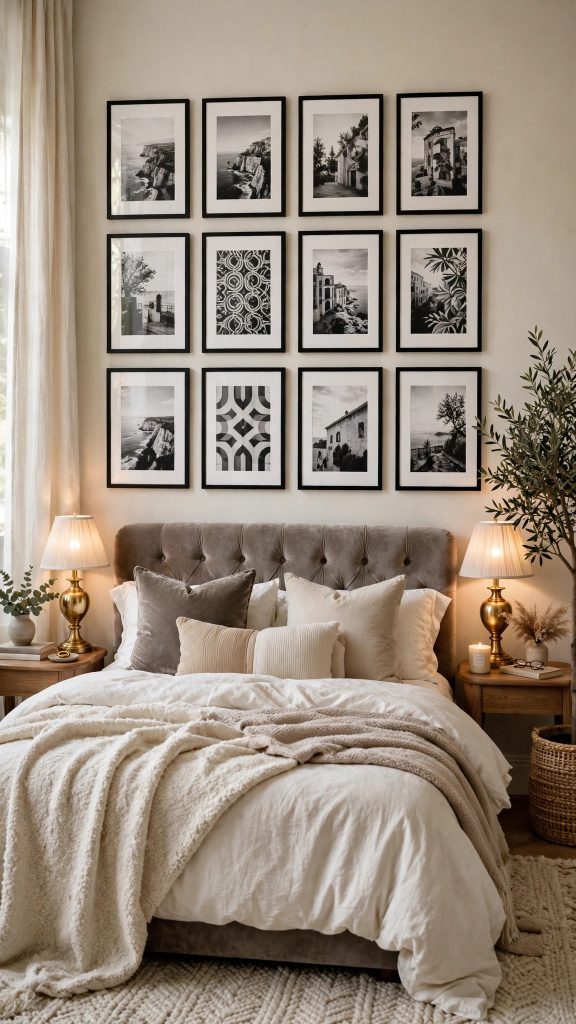
A grid of black-and-white photographs is the most disciplined way to dress the wall above a bed. Stripped of color, images become about light, shadow, and composition, and the strict grid gives the room a gallery calm nothing else quite matches. Travel photography, architectural details, portraits, or moody landscapes all work; the monochrome treatment unifies even unrelated subjects into one coherent statement. This look never dates.
The grid only works if it is precise. Use identical frames — same size, profile, and mat — with 2 to 3 inches of spacing both horizontally and vertically. Six frames (three across, two down) or nine (three by three) fill the space over a queen or king; measure the total footprint and aim for two-thirds of the bed’s width. Use a laser level and a template — never eyeball it, because a grid off by half an inch is visible from the doorway.
Frame choices matter more with monochrome. Thin black frames with wide white mats are the classic gallery treatment and look stunning on a light wall; thin white frames feel more modern on pale rooms. True black-and-white lab prints on matte or fine-art paper beat converted color prints — the tonal range is richer and the blacks deeper. Keep bedding calm and let the photography be the room’s single bold voice.
Final Thoughts
The wall above the bed rewards commitment: one clear idea, executed at the right scale, will always outperform a hesitant mix of too-small pieces. Whether you lean toward woven texture, the discipline of a photography grid, or the romance of vintage oils, the principles are the same — span roughly two-thirds of the bed’s width, keep eight to twelve inches of breathing room above the headboard, and choose a palette that speaks to the bedding below.
Pick the idea that matches the mood you want to wake up to, hang it with the right hardware, and check your work from the doorway. That wall is the first thing you see when you enter and the last thing you see before sleep — give it something worth looking at, and the whole master bedroom will feel finished in a way no amount of throw pillows can achieve alone.